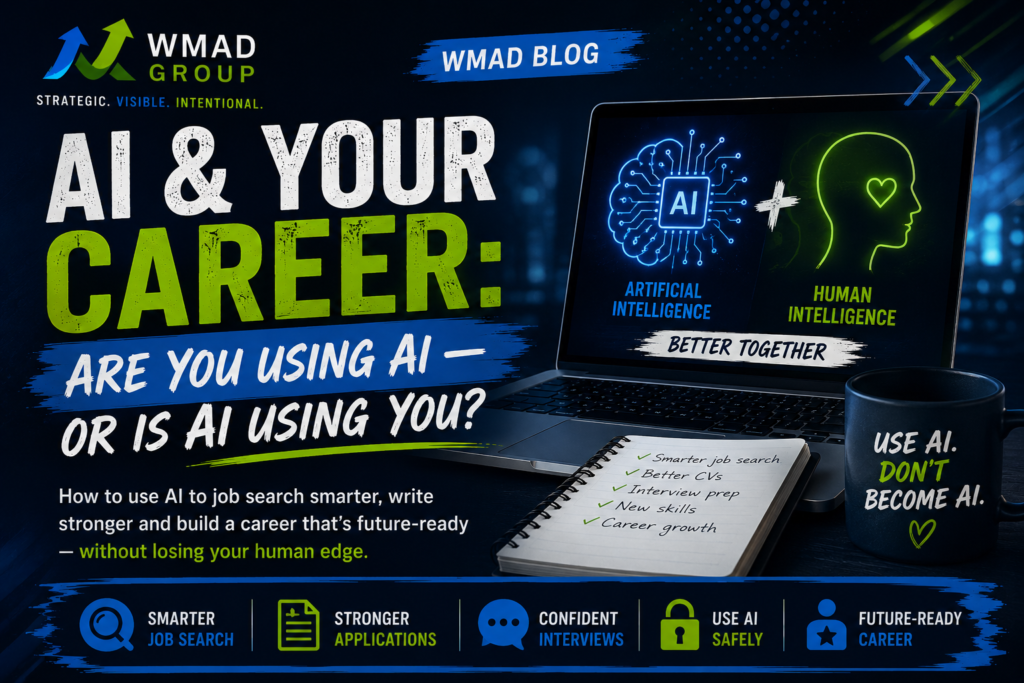
AI is no longer something happening somewhere in the tech world.
It is already changing how people work, search for jobs, write, communicate, learn and build their careers.
And if you’re looking for work right now, ignoring AI probably isn’t the best strategy.
But neither is handing your entire career over to it.
The real opportunity is learning how to use AI without losing the most important thing you bring to the table: YOU.
AI isn’t necessarily replacing you. But someone using AI may have an advantage.
Let’s be realistic.
AI can already help people write emails, analyse information, prepare for interviews, brainstorm ideas, learn new skills and improve documents.
That doesn’t mean every job is disappearing.
It does mean the way we work is changing.
Think about it this way:
AI can help you work faster.
AI can help you learn.
AI can help you prepare.
AI can help you think through a problem.
But AI doesn’t have your lived experience, your relationships, your judgement, your resilience or your understanding of the situation in front of you.
That’s where the human advantage comes in.
So, how can job seekers actually use AI?
1. Use AI to understand a job advert
Instead of simply reading a job advert and thinking:
“I don’t have every requirement.”
Try using AI to analyse it.
You could ask AI to identify:
- The five most important skills in the advert
- Which requirements are essential versus desirable
- Which of your existing skills are transferable
- What keywords appear repeatedly
- Where your experience matches the role
This can help you understand what an employer is actually looking for.
But don’t let AI decide whether you’re suitable.
Use its analysis as another perspective — then make your own judgement.
2. Use AI to improve your CV… not invent your career
This is a big one for us at WMAD.
AI can help you:
- Structure information
- Improve clarity
- Identify repetitive wording
- Suggest stronger ways of presenting genuine achievements
- Compare your CV with a job description
- Identify skills you may have overlooked
But there is a massive difference between:
“Help me explain my real experience more clearly.”
and
“Make me sound like I have 10 years of experience I don’t actually have.”
Never allow AI to manufacture qualifications, experience, achievements or responsibilities.
Your CV still needs to be accurate, authentic and yours.
3. Don’t let AI remove your personality
This is where we see one of the biggest problems.
You can spot an AI-assisted CV because it sometimes sounds like everyone else.
“Results-driven, dynamic, innovative professional with a proven track record of…”
There’s nothing inherently wrong with those words.
The problem is when every candidate uses the same language and there is nothing specific to show what makes them different.
Your CV shouldn’t simply tell an employer:
“I’m excellent.”
It should show them why.
What did you achieve?
What did you improve?
What problems did you solve?
What did you save, grow, manage, build or change?
AI can help you communicate those things.
It shouldn’t make them up.
4. AI can become your interview practice partner
Got an interview coming up?
You can use AI to practise.
Give it the job description and ask it to generate realistic interview questions.
Then practise answering them.
You can even ask AI to identify where your answer is:
- Too vague
- Too long
- Missing an example
- Not answering the question
- Missing a measurable result
You can practise STAR responses.
You can prepare questions to ask the interviewer.
You can even ask AI to challenge you with follow-up questions.
But remember:
Don’t memorise an AI-generated interview script.
The interviewer wants to meet you, not the world’s most polished chatbot.
5. AI can help you discover your skills
This is something we really want to explore more at WMAD.
You may have skills you don’t even recognise as professional skills.
Perhaps you:
- Organise a busy household
- Manage difficult customers
- Train new employees
- Solve problems every day
- Coordinate events
- Manage stock
- Handle money
- Work under pressure
- Resolve conflict
- Communicate with different types of people
AI can help you unpack these experiences and identify the transferable skills behind them.
That’s powerful when you’re considering a career change.
Your job title may describe what you did.
Your skills can help explain what you can do next.
6. But PLEASE don’t put everything into AI
This is one of the most important lessons.
Before copying and pasting information into an AI tool, stop and think.
Don’t casually enter:
❌ ID numbers
❌ Passwords
❌ Banking information
❌ Private client information
❌ Confidential company documents
❌ Sensitive personal information
❌ Information belonging to someone else
AI can be incredibly useful, but common sense and data privacy still matter.
Remove unnecessary personal information before asking an AI tool to help with something.
7. And now we’re entering the era of AI content provenance
Here’s something interesting happening right now.
AI-generated content is increasingly being given signals that can help identify where it came from.
For example, images generated using OpenAI tools currently include C2PA Content Credentials and SynthID invisible watermarking. C2PA is a provenance standard that can carry information about where and how content was created, while SynthID embeds an invisible signal into the media itself.
And this conversation has now moved beyond images.
In August 2026, Anthropic announced that newer Claude models would use imperceptible, machine-readable watermarking in generated text, alongside provenance information for images. The move is connected to emerging AI transparency requirements under the EU AI Act, and Anthropic says the approach is being rolled out globally.
So, no… this doesn’t mean you’ll suddenly see a huge “THIS WAS WRITTEN BY AI” stamp across everything.
These systems are generally designed to be machine-readable or invisible rather than obvious visual stamps.
And they’re not perfect.
Metadata can be stripped, watermark signals can be degraded, and the absence of a detected signal does not prove that something wasn’t created with AI.
The bigger message is about transparency and trust.
What does this mean for job seekers?
This is where it gets interesting.
Imagine a future where employers increasingly expect candidates to understand how to use AI responsibly.
The question may not simply be:
“Can you use AI?”
It could become:
“Do you know how to use AI effectively, ethically and intelligently?”
That’s a very different skill.
Being able to work with AI may become part of your professional toolkit… much like knowing how to use spreadsheets, email, presentation software or industry-specific systems.
But there is another side to this.
Employers still need people who can:
? Think critically
? Build relationships
? Communicate
? Make decisions
❤️ Understand people
? Solve problems
⚡ Adapt when things change
AI can support these things.
It doesn’t automatically replace them.
AI + YOU is the real opportunity
At WMAD, we’re not interested in telling job seekers:
“AI is going to take your job!”
We’d rather say:
Learn it.
Question it.
Use it.
Understand its limitations.
And keep developing the human skills that make you valuable.
Because the future doesn’t have to be:
AI OR humans.
It can be:
AI + HUMAN.
AI can help you analyse.
You provide the judgement.
AI can help you brainstorm.
You provide the experience.
AI can help you practise.
You provide the personality.
AI can help you learn.
You decide what to do with the knowledge.
The WMAD takeaway
Don’t hide from AI.
Don’t blindly trust it either.
And definitely don’t let it pretend to be you.
Use AI as your career assistant… not your career identity.
The people who learn how to work with AI while continuing to develop their own skills, judgement and personality will be in a much stronger position to navigate the changing world of work.
And this is only the beginning.
At WMAD, we’re going to be exploring more about AI, careers, job searching, CVs, interviews, skills and the future of work.
Because the job search is changing.
Let’s learn how to change with it. ??
WMAD Group — Strategic. Visible. Intentional.

