Why 50 applications aren’t necessarily better than 5 strategic ones
If you’ve been job hunting for a while, you’ve probably heard some version of this:
“Just apply for as many jobs as possible.”
So you do.
You apply in the morning.
You apply at lunch.
You apply before bed.
You see another job on LinkedIn.
Apply.
Another one on a job board.
Apply.
Another one that you’re not completely qualified for but think, “Why not?”
Apply.
And after dozens, sometimes hundreds, of applications, you look at your inbox.
Nothing.
Maybe one automated rejection.
Maybe silence.
And eventually you start wondering:
“What’s wrong with me?”
At WMAD, we think there’s another question you should be asking.
Is your job search actually strategic?
Because applying for more jobs isn’t automatically the answer.
Sometimes you don’t need more applications.
You need better applications.
Applying for everything feels productive.
And that’s the trap.
When you’re unemployed or desperately wanting to leave your current job, sending applications can feel like you’re doing something.
And technically, you are.
But there’s a difference between being busy and being effective.
You can spend three hours applying for ten jobs and still make very little progress.
Why?
Because if you’re applying without considering:
- Whether the role actually suits you
- Whether your experience matches
- Whether your CV reflects the role
- Whether you’re using the right keywords
- Whether you can demonstrate the required skills
- Whether the company is somewhere you’d actually want to work
…you’re often just sending the same version of yourself into ten completely different conversations.
And hoping someone says yes.
The “spray and pray” approach
Let’s call it what it is.
You find a job advert.
You upload your CV.
You click Apply.
Next.
Upload.
Click.
Next.
Repeat.
It’s tempting because it gives you a number.
“I’ve applied for 20 jobs this week!”
But what if five well-targeted applications would have been more valuable than those 20?
The goal isn’t to collect application confirmations.
The goal is to find the right opportunity.
So what does a strategic application look like?
It starts before you click Apply.
1. Read the job advert properly.
Not just the job title.
Actually read it.
What will this person be responsible for?
What skills are genuinely important?
What qualifications are essential?
What experience are they asking for?
What words keep appearing?
What problems is this person expected to solve?
The job advert is giving you information.
Use it.
2. Ask yourself: “Is this actually a match?”
Not a perfect match.
A genuine match.
You don’t need to meet every single desirable requirement.
But there should be a reasonable connection between what they need and what you can offer.
Look at:
Experience
Skills
Responsibilities
Industry knowledge
Transferable skills
Qualifications
Then ask:
Can I provide evidence that I can do this work?
If the answer is yes, consider applying.
If the answer is a definite no across most of the role, you may be better spending that time elsewhere.
3. Stop applying for jobs you don’t even want.
This sounds obvious.
But people do it all the time.
They see a salary.
They see the word “permanent”.
They see “remote”.
And suddenly they’re applying.
But ask yourself:
Would I actually want this job?
Would you enjoy the work?
Does it fit your skills?
Does the environment appeal to you?
Is the location realistic?
Does the salary make sense?
Does the role move your career in a direction you actually want to go?
Because getting a job you hate isn’t necessarily a successful job search.
4. Your CV shouldn’t be identical for every application.
This doesn’t mean rewriting your entire CV every single time.
It means making sure the version you’re sending speaks to the role you’re applying for.
If you’re applying for an administration position, the most relevant parts of your experience should be easy to find.
If you’re applying for a customer service role, your customer-facing experience should be clear.
If you’re applying for a management position, leadership, decision-making and results should be visible.
Your CV should help the recruiter answer one very important question:
“Why should I consider this person for THIS role?”
That’s positioning.
5. Don’t just list what you did.
This is something we talk about constantly at WMAD.
There is a huge difference between:
“Responsible for managing customer complaints.”
and:
“Resolved customer complaints, identified recurring issues and helped improve the customer service process.”
The second tells us more.
It gives us:
Action.
Problem-solving.
Impact.
Your CV doesn’t simply need to tell an employer what your job was.
It needs to help them understand what you brought to that job.
6. Use AI strategically.
AI can be incredibly useful during a job search.
But don’t use it to apply for everything.
Use it to help you think.
For example, you can give AI:
Your genuine experience + the job advertisement
and ask it to identify:
- Strong matches
- Transferable skills
- Potential gaps
- Important keywords
- Areas where your experience could be explained more clearly
You can even ask it to challenge you:
“Based on my real experience, what would make a recruiter hesitate to shortlist me for this role?”
That’s much more useful than:
“Write me a CV for this job.”
AI should help you become more strategic.
It shouldn’t turn your job search into an automated application machine.
7. Keep track of what you’re doing.
If you’re applying for dozens of jobs, do you actually remember them?
The company?
The role?
The closing date?
What CV you sent?
Who you contacted?
Whether you’ve followed up?
Create a simple application tracker.
You don’t need anything fancy.
A spreadsheet can include:
Company
Position
Date applied
Closing date
Contact person
Status
Follow-up date
Notes
This gives you something extremely valuable:
A picture of your actual job search.
8. Look at your results… not just your application count.
This is where things get interesting.
Imagine you’ve sent:
40 applications
and received:
0 interviews.
The answer isn’t necessarily:
“I need to apply for another 40.”
It might be:
“Something in my strategy needs attention.”
Look at the pattern.
Are you applying for roles that don’t match your experience?
Is your CV failing to communicate your value?
Are you applying too late?
Are you relying entirely on online applications?
Are you ignoring networking?
Is your LinkedIn profile working against you?
Are you applying for completely different types of roles with the same CV?
Your results are giving you information.
Pay attention to it.
The WMAD Strategic Application Check
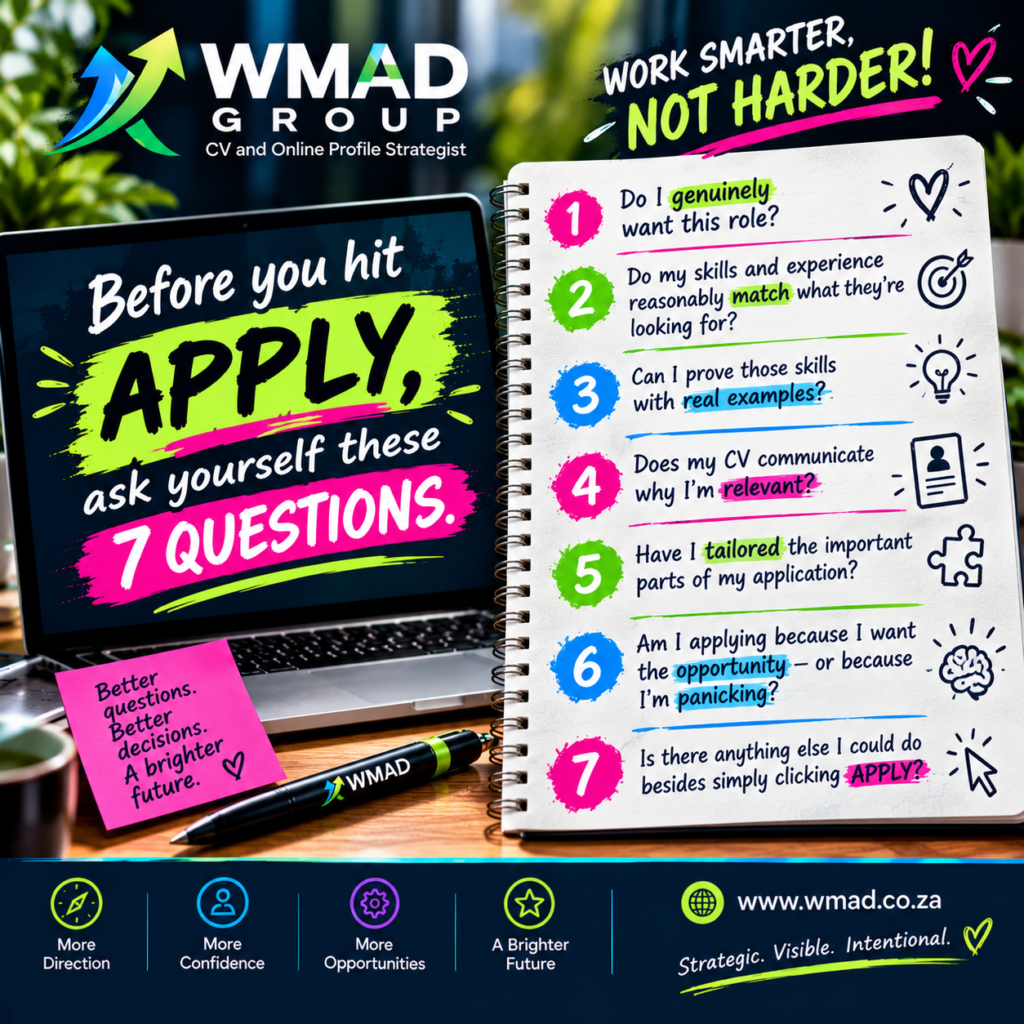
Before you hit APPLY, ask yourself these seven questions:
1. Do I genuinely want this role?
2. Do my skills and experience reasonably match what they’re looking for?
3. Can I prove those skills with real examples?
4. Does my CV communicate why I’m relevant?
5. Have I tailored the important parts of my application?
6. Am I applying because I want the opportunity… or because I’m panicking?
7. Is there anything else I could do besides simply clicking APPLY?
That last question matters.
Maybe you could:
Connect with someone at the company.
Reach out to a recruiter.
Use your network.
Research the organisation.
Improve your LinkedIn profile.
Prepare for the interview before you’re even invited.
The application is only one part of the job search.
And please don’t measure your worth by your application count
This might be the most important part.
If you’ve applied for 50 jobs and haven’t heard back, that doesn’t mean you’re useless.
It doesn’t mean you’re unemployable.
It doesn’t mean you have nothing to offer.
It means something isn’t working yet.
And that’s different.
You can change your strategy.
You can improve your positioning.
You can identify your transferable skills.
You can strengthen your CV.
You can build your network.
You can learn.
You can try something different.
You are not your rejection emails.
Five strategic applications can beat fifty random ones.
We’re not saying you should only apply for five jobs.
We’re saying:
Stop measuring success by how many times you click APPLY.
Measure it by whether you’re getting closer to the right opportunity.
A strategic job search might look like this:
Find the right role.
↓
Understand what they need.
↓
Position your experience.
↓
Tailor your application.
↓
Make yourself visible.
↓
Follow up strategically.
↓
Learn from the result.
↓
Improve and repeat.
That’s a job search.
Not just an application marathon.
The WMAD takeaway
If you’re exhausted from applying for jobs, maybe the answer isn’t to apply for more.
Maybe it’s time to step back.
Look at what you’re applying for.
Look at how you’re presenting yourself.
Look at your results.
And ask:
“What could I do differently?”
Because you don’t need to be everywhere.
You need to be visible in the right places.
You don’t need to convince every employer.
You need to connect with the right opportunity.
And you don’t need 100 applications to prove that you’re serious about finding work.
You need a strategy that helps the right employer see your value.
So this week…
Don’t just apply.
Apply strategically.
????????
WMAD Group
Strategic. Visible. Intentional.

