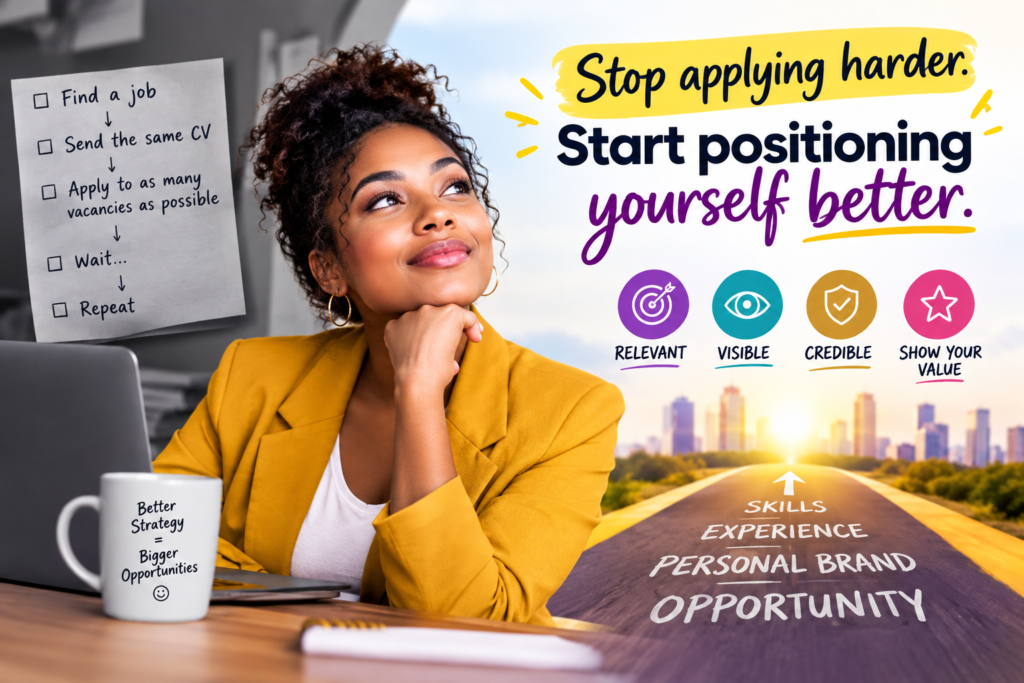
Stop applying harder. Start positioning yourself better.
The job search has changed.
And if your strategy is still find a job → send the same CV → apply to as many vacancies as possible → wait → repeat, we need to talk.
Because in 2026, getting noticed isn’t simply about being qualified. It’s about being relevant, visible, credible and able to show what you actually bring to the table.
LinkedIn’s 2026 research found that nearly two-thirds of people say finding a job has become more difficult, while 66% of recruiters say finding qualified talent has also become harder. At the same time, 93% of recruiters surveyed said they planned to increase their use of AI, and 59% said AI was already helping them discover candidates with skills they might otherwise have missed.
So yes… the game is changing.
But here’s the good news:
You don’t need to become a completely different candidate.
You need to get better at showing the value you already have.
1. STOP MEASURING YOUR JOB SEARCH BY HOW MANY JOBS YOU APPLY FOR
This is one of the biggest mindset shifts we want job seekers to make.
Twenty applications aren’t automatically better than three.
If you’re applying for anything and everything because you’re desperate for a response, you’re probably spending enormous amounts of energy producing applications that don’t give you much chance of success.
Instead, ask:
“Is this actually a role where I can demonstrate my value?”
Before applying, look at:
- The actual responsibilities.
- The skills being requested.
- The problems the employer needs this person to solve.
- Where your experience matches.
- Where you have transferable skills.
- Whether your CV clearly demonstrates those things.
Quality and relevance matter.
And with AI making it easier for both employers and candidates to process huge volumes of information, simply increasing your application volume isn’t necessarily the answer.
2. YOUR CV IS NOT YOUR CAREER
We say this a lot at WMAD because it’s important.
Your CV is a marketing document.
It isn’t your autobiography.
It doesn’t need to contain every task you’ve ever performed since leaving school.
And it definitely doesn’t need six paragraphs explaining that you’re:
hard-working, motivated, dedicated, reliable, passionate and a team player.
Show us.
If you say you’re a problem solver, what problem did you solve?
If you say you’re organised, what did you organise?
If you say you’re a leader, who did you lead and what changed because of it?
If you say you’re adaptable, when have you had to adapt?
Recruiters need evidence.
Don’t just tell them who you are. Give them reasons to believe you.
3. YOUR “ORDINARY” EXPERIENCE MAY NOT BE ORDINARY AT ALL
This is something we’ve been exploring through our Skill Reveal content.
People constantly underestimate themselves.
“I just train the new people.”
That’s mentoring.
“I’m always the one people come to when something goes wrong.”
That’s problem-solving.
“I organise everyone’s shifts.”
That’s planning, coordination and resource management.
“I deal with difficult customers all day.”
That’s communication, emotional intelligence, conflict resolution and resilience.
“I taught myself how to use the new system.”
That’s initiative, adaptability and digital learning.
The skill was already there.
You just weren’t calling it a skill.
This is why we encourage job seekers to stop looking only at their job title and start looking at what they actually do, solve, manage, improve and influence.
That is where your real career story lives.
4. AI IS PART OF THE JOB SEARCH… BUT IT IS NOT YOU
We’re not anti-AI at WMAD.
Quite the opposite.
We’re embracing it.
But there’s a massive difference between:
using AI intelligently
and
letting AI do your thinking for you.
AI can help you:
- Identify transferable skills.
- Analyse a job advertisement.
- Find gaps in your CV.
- Brainstorm stronger achievement statements.
- Prepare interview questions.
- Practise interview answers.
- Research an industry.
- Improve clarity and grammar.
- Compare your experience against a vacancy.
- Find better ways to communicate your real experience.
What it shouldn’t do is invent your experience.
And please don’t turn every application into the same polished AI-generated essay.
Recruiters are increasingly using AI too. LinkedIn’s research shows AI is becoming more embedded in sourcing and pre-screening, while human judgement remains important further through the process.
So here’s our rule:
Use AI to uncover your value. Don’t use AI to manufacture it.
5. AND YES… AI AUTHENTICITY IS BECOMING A BIGGER CONVERSATION
This is an area job seekers need to start understanding.
AI-generated content is increasingly being accompanied by provenance signals designed to indicate where content came from.
For example, OpenAI says its generated images include C2PA provenance metadata and SynthID watermarking, while Anthropic announced in August 2026 that future Claude-generated text would include an invisible watermark designed to indicate the likelihood that Claude was involved in producing it.
But here’s the important part:
A watermark doesn’t mean something is good, bad, true or false.
It is about provenance … where content came from or whether AI was involved.
For job seekers, the bigger lesson is simple:
Don’t become obsessed with trying to “beat” AI detection.
Instead, make sure your application is genuinely yours.
Your experiences.
Your achievements.
Your voice.
Your examples.
Your thinking.
AI can help you polish the message.
It shouldn’t become the person applying for the job.
6. YOUR HUMAN SKILLS ARE NOT BECOMING IRRELEVANT
This is possibly one of the biggest misconceptions about AI.
People hear:
“AI is changing jobs.”
And immediately think:
“Then my human skills don’t matter anymore.”
Actually, the opposite may be happening.
PwC’s 2026 Global AI Jobs Barometer analysed more than one billion job advertisements and found that skills in AI-exposed roles are changing more than twice as fast as those in less-exposed roles. It also found that AI-exposed junior roles were substantially more likely to demand traditionally senior skills such as leadership and judgement.
Think about what employers still need:
Judgement.
Communication.
Leadership.
Creativity.
Adaptability.
Problem-solving.
Emotional intelligence.
Relationship building.
AI can give you an answer.
You still need to decide whether it’s the right answer.
That’s a career skill.
7. YOUR LINKEDIN PROFILE IS PART OF YOUR JOB SEARCH
Your CV may get you considered.
But what happens when someone searches your name?
Your LinkedIn profile.
Your digital footprint.
Your professional presence.
Your online activity.
Your Career Glow Card.
Your networking conversations.
All of these can contribute to the picture someone forms of you.
So don’t treat LinkedIn as a digital CV you update once every three years.
Ask yourself:
If a recruiter looked at my profile today, would they understand what I do, what I’m good at and what kind of opportunity I’m looking for?
If the answer is “not really”…
There’s work to do.
8. START THINKING LIKE THE RECRUITER
This is exactly why we created The Recruiter’s Desk.
Stop looking at a vacancy only as:
“Can I get this job?”
Look at it from the other side:
“Why would they choose me?”
Imagine you’re the recruiter.
You’ve opened 100 CVs.
What makes you stop?
What makes you keep reading?
What makes you think:
“I want to speak to this person.”
And just as importantly…
What makes you move on?
This is where clarity matters.
A recruiter shouldn’t have to dig through three pages to figure out what you actually do.
Make the value obvious.
9. STOP TRYING TO BE EVERYTHING
Here’s an unpopular opinion:
You do NOT need to apply for every job you’re technically qualified for.
Being qualified doesn’t automatically mean you’re a strong match.
And being rejected doesn’t automatically mean you’re not good enough.
Sometimes the role simply isn’t the right fit.
Sometimes your experience isn’t being communicated properly.
Sometimes your CV isn’t making the connection.
Sometimes there are stronger candidates.
Sometimes the hiring process is flawed.
Sometimes the vacancy isn’t even what it appears to be.
Your job is not to control everything.
Your job is to control your positioning, your preparation and your strategy.
10. YOUR 2026 JOB SEARCH RESET
So, if your job search has started feeling like a never-ending cycle of:
Apply.
Wait.
Refresh inbox.
Get rejected.
Apply again.
Question your entire existence.
Repeat.
Stop.
Reset.
Ask yourself:
CV
☐ Does my CV clearly show what I can do?
Skills
☐ Have I identified the skills hiding inside my everyday experience?
Achievements
☐ Have I shown evidence rather than simply listing responsibilities?
AI
☐ Am I using AI as a career assistant rather than letting it speak for me?
LinkedIn
☐ Does my online presence support the career I want?
Visibility
☐ Can people quickly understand what I do and what I bring?
Applications
☐ Am I applying strategically rather than desperately?
Interviews
☐ Can I explain my value with real examples?
Human skills
☐ Can I demonstrate adaptability, communication, judgement, problem-solving and initiative?
Mindset
☐ Am I measuring progress only by job offers — or also by how much stronger my career positioning is becoming?
THE BIGGEST RESET OF ALL
The job search isn’t simply:
“Find vacancy. Send CV.”
It’s a whole ecosystem.
Your CV.
Your skills.
Your LinkedIn.
Your visibility.
Your network.
Your communication.
Your interview performance.
Your ability to tell your story.
Your understanding of what employers actually need.
And now…
Your ability to work alongside AI without losing the human being behind the application.
That’s the 2026 job search.
And that’s where WMAD wants to help.
Because we don’t believe you need to become someone else to get hired.
We believe you need to get better at showing people why they should hire YOU.
That’s the reset.
And this Monday, don’t ask yourself:
“How many jobs did I apply for?”
Ask:
“Did I make myself easier to recognise, understand and remember?”
Because sometimes the next step isn’t applying harder.
It’s positioning smarter.

