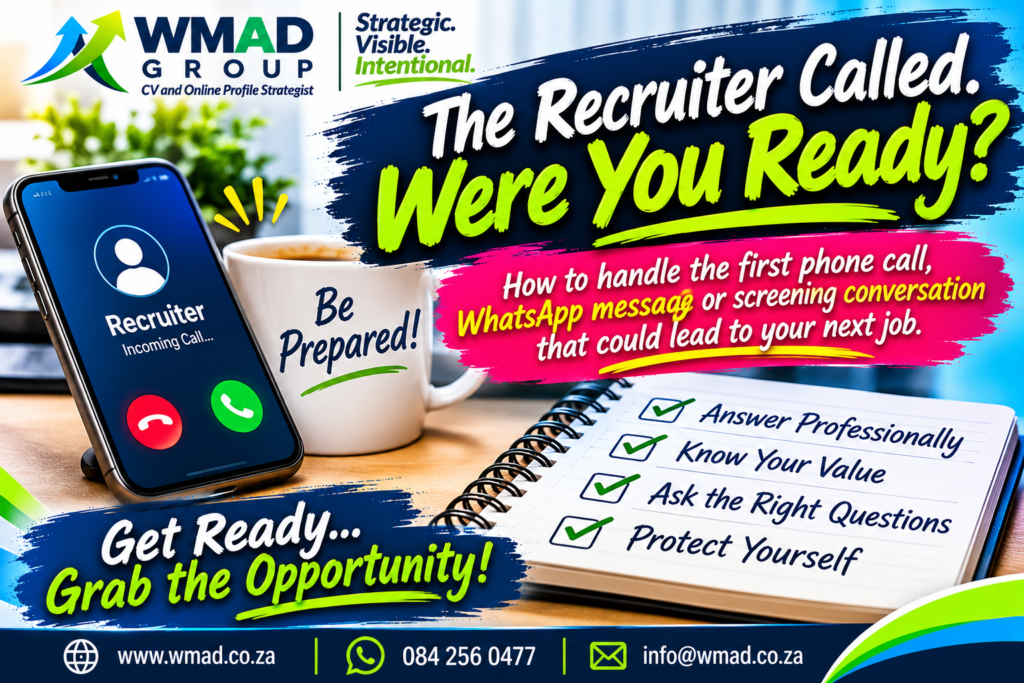
The Recruiter Called. Were You Ready?
How to handle the first phone call, WhatsApp message or screening conversation that could lead to your next job.
You’ve sent your CV.
You’ve applied for the position.
You’ve checked your email approximately 47 times.
And then… your phone rings.
An unfamiliar number.
You answer, and someone says:
“Good morning. Am I speaking to [your name]? I’m calling regarding your application…”
Suddenly, your mind goes blank.
Who is calling? Which position did you apply for? What did the advert say? What salary did they offer? And why does your voice suddenly sound like you’ve never spoken to another human being before?
Sound familiar?
Here’s something many job seekers overlook:
Your interview preparation shouldn’t start when you walk into the interview room. It should start when the opportunity first makes contact.
That first conversation could be a phone call, an email, a WhatsApp message or a short screening discussion with a recruiter.
And while it may not be the formal interview, it is still an opportunity to make a professional impression.
Let’s get you ready.
1. The unexpected phone call: Don’t panic!
Recruiters don’t always schedule their first calls.
Sometimes they phone to confirm your interest, check your availability, ask a few basic questions or arrange an interview.
The problem?
You might be driving, working, shopping, standing in a queue or simply not expecting the call.
First things first: you don’t have to conduct an important conversation when you’re not in a position to do so.
If you’re somewhere noisy or distracted, respond professionally.
Try:
“Good morning. Thank you for calling. I’m interested in the opportunity. I’m unfortunately not in a position to speak properly at the moment. Would it be possible to call you back in about 20 minutes?”
That’s perfectly reasonable.
If you miss the call, don’t immediately assume you’ve lost the opportunity.
Return the call as soon as reasonably possible, or send a brief, professional message if you have a number to respond to.
For example:
“Good morning. I noticed I missed your call. My apologies. I’m available to speak and would appreciate the opportunity to return your call. Kind regards, [Your Name].”
A missed call isn’t necessarily a missed opportunity. How you respond matters.
2. Keep track of the jobs you’ve applied for.
Here’s where a little organisation can save you from an awkward conversation.
Imagine a recruiter phones and says:
“We received your application for our administrative position.”
And you respond:
“Which company was that again?”
It happens.
When you’re applying for multiple positions, it’s easy to lose track.
Keep a simple job application tracker with:
- Company name
- Position applied for
- Date of application
- Where you found the vacancy
- Contact person, if known
- Salary advertised, if provided
- Application status
- Any follow-up dates
Before answering or returning a call, take a moment to check your records.
You should also keep copies of the job adverts or descriptions where possible.
You don’t need an elaborate system. A spreadsheet or simple document will do.
The goal is to know which opportunity you’re discussing before the conversation gets underway.
3. The WhatsApp message: Professional doesn’t mean complicated
In South Africa, job-related communication may arrive through WhatsApp, particularly when recruiters or smaller businesses use it to make initial contact.
But don’t confuse a convenient communication channel with an invitation to be careless.
You don’t need to write an essay.
You do need to be clear, polite and professional.
Imagine receiving:
“Hi, we saw your CV. Are you available for an interview?”
A suitable response could be:
“Good afternoon. Thank you for contacting me. Yes, I am available and would be interested in attending an interview. Please let me know the proposed date, time and location. Kind regards, [Your Name].”
If you’re unavailable at the suggested time:
“Thank you for the invitation. I would be very interested in attending. Unfortunately, I am unavailable at that time. Would another time be possible?”
A few simple reminders:
- Use a professional profile name and photograph where possible.
- Avoid replying with one-word answers when more information is needed.
- Check spelling before sending.
- Don’t send multiple messages because someone hasn’t replied immediately.
- Keep your tone polite, even if the recruiter is informal.
And please, don’t respond to a professional opportunity with:
“Who dis?”
We know you’re curious. Just ask a little more professionally. ????
4. Be ready for the question: “Tell me a little about yourself”
This question can appear during a phone screening, a video call or a formal interview.
And it catches people off guard because it sounds so simple.
The recruiter isn’t asking you to tell your entire life story.
They’re looking for a brief introduction that helps them understand your professional background and what you’re looking for.
Try preparing a natural 30–60 second introduction.
A useful structure is:
Who you are professionally.
What experience or skills you bring.
What type of opportunity you’re looking for.
For example:
“I have experience in customer service and retail, where I’ve developed strong communication, problem-solving and organisational skills. I’m now looking to move into an administrative role where I can use those skills while developing further experience in office support.”
If you’re a recent graduate:
“I’m a recent graduate with a qualification in [field]. I’m looking for an entry-level opportunity where I can apply what I’ve learned, gain practical experience and contribute while continuing to develop professionally.”
If you’re returning to work:
“I have previous experience in [industry or role] and am now looking to return to the workplace. I bring experience in [relevant skills] and am particularly interested in opportunities involving [area of interest].”
Don’t memorise a script word for word.
Know your key points and practise saying them naturally.
You want to sound prepared, not rehearsed.
5. Salary expectations: Don’t let the question catch you off guard
This is one question worth preparing for before the phone rings.
A recruiter might ask:
“What are your salary expectations?”
Or:
“What were you earning in your previous position?”
You don’t want to be forced into giving an answer without thinking.
Before applying, research the role and consider:
- The responsibilities involved
- Your experience and qualifications
- The industry
- The location
- The level of the position
- Your own realistic salary requirements
If the salary hasn’t been advertised, you can ask:
“Would you be able to share the budgeted salary range for the position?”
If you’re asked for your expectations, you could say:
“Based on the responsibilities of the role and my experience, I’m looking in the region of [amount or range], although I’d be happy to consider the overall package.”
Only give a range you’ve genuinely considered and would be comfortable discussing.
And remember: salary isn’t the only thing worth understanding. Benefits, working hours, location, travel requirements and contract conditions can also affect whether an opportunity is suitable.
6. Know your own availability and work preferences
A recruiter may ask questions that seem straightforward:
- When can you start?
- Are you currently employed?
- What is your notice period?
- Are you available for shift work?
- Can you work weekends?
- Are you able to travel?
- Do you have reliable transport?
- Are you willing to relocate?
- Are you comfortable with office-based, hybrid or remote work?
These questions help establish whether the opportunity fits your circumstances.
Don’t say yes to everything just because you want the job.
If you cannot work weekends, don’t promise that you can.
If you need to give notice, be honest about it.
If the role is in another area, understand the travel requirements before committing.
Being clear about your availability now can prevent misunderstandings later.
7. Ask questions too — this is a conversation
When someone contacts you about a job, it’s easy to feel as though you must simply answer whatever they ask.
But you are also entitled to understand the opportunity.
Depending on what has already been explained, useful questions might include:
- Could you tell me a little more about the responsibilities?
- Where is the position based?
- Is this a permanent, fixed-term or temporary role?
- What are the expected working hours?
- Has the salary range been established?
- What is the next stage of the recruitment process?
You don’t need to ask every question in the first conversation.
Choose the ones that are relevant and haven’t already been answered.
And if something isn’t clear, ask for clarification.
Professional communication is a two-way street.
8. A word of caution: Not every recruiter message is genuine
This is particularly important when you’re actively looking for work.
Unfortunately, job seekers can be targeted by scams that use the excitement and urgency of finding employment.
Be cautious if someone:
- Asks you to pay an application, registration or placement fee to secure a job.
- Requests banking details or sensitive personal information unnecessarily.
- Offers a job without a credible recruitment process.
- Uses pressure tactics to make you act immediately.
- Sends suspicious links or requests that you download unfamiliar files.
- Cannot provide verifiable company or vacancy details.
A legitimate recruitment process may require personal information at an appropriate stage, but you should understand why it is being requested and how it will be used.
Verify the company and recruiter independently.
Don’t assume a message is genuine simply because it includes a company logo or uses professional-sounding language.
And never share passwords, PINs or one-time banking verification codes.
Being eager for an opportunity should never mean switching off your judgement.
9. What happens after the first conversation?
The call ends.
The recruiter says they’ll be in touch.
Now what?
First, make a note of what was discussed.
Record:
- The recruiter’s name
- The company
- The position
- Any information shared
- Documents requested
- Interview arrangements
- Expected next steps
- When you should follow up, if a timeframe was given
If an interview has been arranged, confirm the details.
For example:
“Thank you for the call. I confirm my availability for the interview on 2026 at [time]. I look forward to meeting with you. Kind regards, [Your Name].”
If you haven’t heard back within the timeframe discussed, a polite follow-up is reasonable.
You could write:
“Good morning. I hope you’re well. I’m following up on our recent conversation regarding the [position] opportunity. I remain interested and would appreciate any update regarding the next steps. Kind regards, [Your Name].”
Avoid sending repeated messages every few hours.
Give the recruitment process reasonable time.
10. Your five-minute preparation checklist
You don’t need to spend hours preparing for every possible phone call.
But you can make sure the basics are ready.
Before your next application goes out, check that you have:
☐ A professional voicemail greeting.
☐ Your email address and WhatsApp profile looking professional.
☐ A copy of your latest CV easily accessible.
☐ A record of the positions you’ve applied for.
☐ A short introduction about your experience and skills.
☐ An idea of your salary expectations.
☐ Your notice period or availability confirmed.
☐ Your preferred work locations and arrangements clear.
☐ A quiet place where you can take an important call or arrange to call back.
☐ A few sensible questions ready to ask.
You don’t need to predict when an opportunity will contact you.
You just need to be ready when it does.
The WMAD Takeaway: Your Job Search Starts Before the Interview
We spend a lot of time helping job seekers prepare their CVs, improve their LinkedIn profiles and get ready for interviews.
But there’s another part of the process that deserves attention.
The first interaction.
That unexpected call.
That WhatsApp message.
That quick conversation that could determine whether you move to the next stage.
You don’t need to be perfect.
You don’t need to have every answer ready.
You do need to communicate clearly, show genuine interest, understand your own circumstances and remain alert to anything that doesn’t feel right.
And please remember:
You are not begging someone to give you a chance.
You are having a professional conversation about whether your skills, experience and expectations are a good match for an opportunity.
That mindset makes a difference.
At WMAD, we want job seekers to be more than application-ready.
We want you to be opportunity-ready.
Because the next opportunity might not arrive with a formal interview invitation.
It might start with a phone ringing.
Will you be ready to answer?
WMAD Group — Strategic. Visible. Intentional.

