Your job title tells us where you’ve been. Your skills tell us what you can do next.
There is a question we hear from job seekers all the time:
“But I don’t have the experience.”
Sometimes they mean they don’t have experience in the exact job they’re applying for.
Sometimes they mean they haven’t worked for a big company.
Sometimes they mean they have been out of the workplace for a while.
And sometimes they simply don’t recognise the experience they already have.
Because here’s the thing:
Experience doesn’t only come from having the “right” job title.
You may have been gaining valuable skills for years without ever putting a label on them.
And those skills could be much more relevant to your next career move than you realise.
Your experience is bigger than your employment history
When you look at your CV, what do you see?
Usually:
Company → Job title → Dates → Duties
That’s important.
But it isn’t the whole story.
Think about everything you’ve done outside a traditional job description.
Have you:
- Run a small side business?
- Freelanced?
- Sold products or services?
- Managed social media for a business?
- Volunteered?
- Organised an event?
- Trained or mentored someone?
- Managed stock?
- Handled money?
- Dealt with difficult customers?
- Coordinated people?
- Solved problems?
- Managed suppliers?
- Worked with deadlines?
- Planned projects?
- Managed a busy household?
- Helped with a family business?
- Taken responsibility for something when nobody else would?
Those experiences may not have come with an impressive job title.
But they still taught you things.
And employers aren’t only hiring job titles.
They’re hiring people who can do things.
Your side hustle counts
Let’s say you have been unemployed for a while.
But during that time, you started selling baked goods from home.
You might look at that and think:
“That’s not real work experience.”
We disagree.
You may have:
- Managed customers
- Taken orders
- Handled payments
- Managed stock
- Calculated costs
- Promoted your products
- Managed social media
- Organised deliveries
- Solved customer problems
- Managed your time
- Kept records
That’s not “nothing.”
That’s a collection of transferable skills.
The important part is being honest about what you actually did.
Don’t turn a small side business into “CEO of a multimillion-rand enterprise.”
But don’t pretend it never happened either.
Own the experience.
Volunteering is experience too
Perhaps you’ve volunteered at a school, charity, community organisation, church, sporting club or local initiative.
You might simply describe it as:
“Volunteer.”
And leave it there.
But what did you actually do?
Maybe you:
- Coordinated volunteers
- Managed registrations
- Organised events
- Communicated with the public
- Managed social media
- Handled donations
- Kept records
- Assisted with administration
- Resolved problems
- Worked with different people
Suddenly, “volunteering” becomes much more meaningful.
The lesson?
Don’t just name the activity. Explain the skills behind it.
Informal leadership is still leadership
Here’s another one we see regularly.
Someone says:
“I’ve never been a manager.”
Then, five minutes later, they tell us they’ve trained every new person who joined their team for the last three years.
????
Let’s pause there.
You may not have had “Manager” written on your business card.
But you may have developed skills in:
- Coaching
- Mentoring
- Training
- Communication
- Delegation
- Problem-solving
- Supporting colleagues
- Sharing knowledge
Those are valuable professional skills.
Again, we’re not suggesting you claim a management position you never held.
We’re saying:
Don’t overlook the leadership behaviours you actually demonstrated.
Managing a household can involve serious skills
This one can be controversial, but let’s talk about it.
If you’ve spent years managing a household, raising children, coordinating appointments, organising schedules, managing budgets, dealing with unexpected problems and keeping everything moving…
you have probably developed a significant number of skills.
That doesn’t automatically make someone qualified for a specific professional position.
But it can provide transferable evidence.
Organisation.
Planning.
Prioritisation.
Communication.
Problem-solving.
Time management.
Adaptability.
Budget management.
Coordination.
The key is not to pretend household responsibilities are the same as professional employment.
The key is to identify the genuine skills you’ve developed through those experiences and consider where they may transfer.
Career changes are where this really matters
Imagine you’ve spent ten years working in retail.
Now you want to move into administration.
You might look at an administration job advertisement and think:
“I don’t have administration experience.”
But let’s look again.
Perhaps you have:
Customer service experience.
→ Communication
→ Conflict resolution
→ Problem-solving
Stock responsibilities.
→ Record keeping
→ Accuracy
→ Inventory management
Cash-up responsibilities.
→ Financial accuracy
→ Reconciliation
→ Attention to detail
Training new employees.
→ Communication
→ Mentoring
→ Knowledge sharing
Opening and closing the store.
→ Responsibility
→ Procedures
→ Time management
Suddenly, the conversation changes.
You’re no longer saying:
“I have no relevant experience.”
You’re saying:
“I have relevant skills that can transfer into this type of role.”
That is a very different starting point.
Stop thinking only in job titles
One of the biggest mistakes job seekers can make is believing:
Job title = experience.
It doesn’t.
A job title is simply one way of describing your role.
Your actual experience is made up of the things you:
Did.
Solved.
Managed.
Improved.
Created.
Organised.
Learned.
Handled.
Achieved.
That’s where your value starts becoming visible.
Try this exercise
Take a blank page.
Don’t start with your CV.
Start with your life and work experience.
Write down every significant thing you’ve done.
Include:
Paid work
Every job you’ve held — even short-term or temporary work.
Informal work
Side hustles, freelance projects, family businesses and paid work that didn’t necessarily have a formal employment structure.
Volunteering
Community projects, organisations, events and initiatives.
Projects
Things you’ve organised, built, managed or improved.
Responsibilities
Times when other people relied on you to make something happen.
Learning
Courses, certifications, self-taught skills and practical knowledge.
Then ask yourself:
What skills were involved?
This is where the gold often appears.
Don’t just list the skill. Find the evidence.
There’s a big difference between saying:
“I’m organised.”
and saying:
“I coordinated weekly schedules for a team of eight people while managing customer deadlines and stock requirements.”
The second statement gives us something to work with.
Instead of:
“I’m good with customers.”
Think:
“I handled high-volume customer enquiries, resolved complaints and maintained relationships with repeat customers.”
Instead of:
“I’m a problem solver.”
Think:
“I identified recurring stock discrepancies and introduced a simple checking process that reduced errors.”
The more specific you can be, the easier it becomes for someone else to understand your value.
Your CV should connect the dots
This is where your CV becomes important.
Your CV shouldn’t simply contain a list of everything you’ve ever done.
It needs to help the reader understand:
What can this person bring to this role?
That means your experience needs to be presented in a way that makes relevant skills easier to see.
And this is especially important when you’re:
- Changing careers
- Returning to work
- Applying after unemployment
- Moving from informal to formal employment
- Moving between industries
- Applying for your first professional role
- Trying to step into a different level of responsibility
You may have more relevant experience than you initially thought.
Your CV’s job is to help communicate it.
But don’t manufacture experience
There is an important line here.
Finding your transferable skills does not mean making your experience sound bigger than it was.
Don’t invent job titles.
Don’t exaggerate responsibilities.
Don’t manufacture achievements.
Don’t turn helping with a family business into being the “Operations Director.”
Don’t claim expertise you don’t have.
Translate your real experience. Don’t rewrite your history.
That’s an important difference.
AI can help you uncover what you’re overlooking
This is also an area where AI can be useful.
You could give an AI tool a description of your real experience and ask:
“Identify the transferable skills demonstrated in this experience. Ask me questions where you need more information. Do not invent qualifications, responsibilities or achievements.”
That can help you see possibilities you hadn’t considered.
But don’t let AI decide who you are professionally.
And don’t simply copy whatever it produces.
Check it. Correct it. Add your real examples. Make it sound like you.
The goal is to uncover your experience — not manufacture a new one.
Your next opportunity might be closer than you think
You don’t necessarily need to start your career again from zero just because you’re changing direction.
Sometimes the next step is hiding inside the experience you already have.
A retail worker may have strong customer service, administration and stock-management skills.
A receptionist may have coordination, communication and scheduling experience.
A parent returning to work may have years of organisational and problem-solving experience that needs to be translated into a professional context.
A freelancer may have project management, client communication and business-development experience.
A small-business owner may have worn ten different hats without realising how many professional skills that developed.
Your previous experience doesn’t have to disappear just because you’re looking for something different.
It can become the bridge to what’s next.
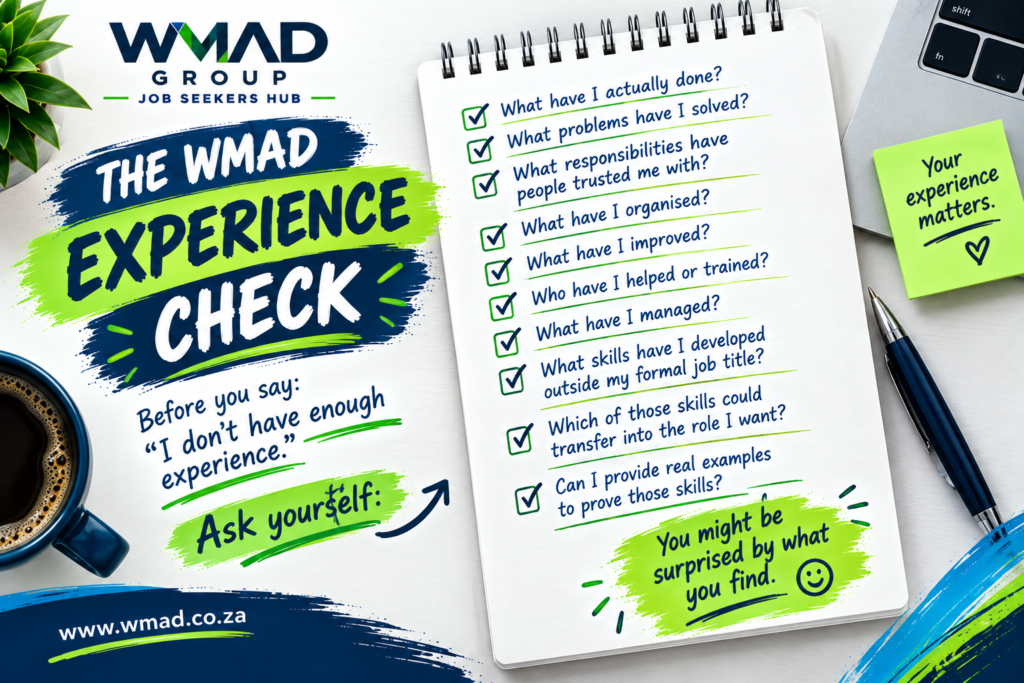
The WMAD Experience Check
Before you say:
“I don’t have enough experience.”
Ask yourself:
☐ What have I actually done?
☐ What problems have I solved?
☐ What responsibilities have people trusted me with?
☐ What have I organised?
☐ What have I improved?
☐ Who have I helped or trained?
☐ What have I managed?
☐ What skills have I developed outside my formal job title?
☐ Which of those skills could transfer into the role I want?
☐ Can I provide real examples to prove those skills?
You might be surprised by what you find.
Your experience is not just your job title
This is the part we really want job seekers to remember.
Your job title tells us where you’ve been.
Your skills tell us what you can do.
And sometimes the reason you feel stuck isn’t because you have no experience.
It’s because you’ve never stopped to recognise the experience you already have.
So before you tell yourself:
“I’m not qualified.”
Take another look.
You might not have the exact job title.
You might not have followed the traditional career path.
You might not have done things in the conventional order.
But that doesn’t mean you have nothing to offer.
It might simply mean you need to connect the dots.
And that’s what a good job search is partly about:
Not pretending to be someone you’re not.
Not exaggerating what you’ve done.
But learning how to clearly communicate the value of what you actually bring.
At WMAD, we believe your career story is bigger than your job title.
Sometimes you just need to look at it differently.
WMAD Group — Strategic. Visible. Intentional. ????????

