Stop listing what you did. Start showing employers why it matters.
Have you ever looked at your CV and thought, “But I’ve done so much more than this shows”?
Maybe you’ve spent years working hard, solving problems, helping customers, managing responsibilities, and keeping things running.
You know what you’re capable of.
You know the experience you’ve gained.
But when you put it all into your CV, something gets lost.
Your CV ends up looking like a list of duties instead of a picture of the professional you actually are.
And that could be one of the reasons your application isn’t getting the attention you hoped for.
Let’s talk about it.
Your job title doesn’t tell the whole story.
A job title tells an employer where you’ve worked or what position you’ve held.
It doesn’t automatically tell them:
- What you achieved
- What problems did you solve
- What you improved
- How you helped a team or business
- What responsibilities you handled independently
- What makes your experience valuable in their workplace
Two people can have exactly the same job title and completely different levels of experience, responsibility, and impact.
That’s why simply listing your previous positions isn’t always enough.
Employers need to understand not only what you did, but also what you brought to the role.
The difference between listing duties and showing value
Let’s look at a few everyday examples.
Example 1: Administration
A duty-focused CV might say:
“Responsible for filing, data capturing, and general administration.”
That tells us what the person did, but very little about how they performed or what their work supported.
A stronger version might say:
“Maintained accurate records, captured information, and supported daily administrative processes to keep documentation organized and accessible.”
This gives the reader more context without inventing achievements.
If the candidate can provide genuine evidence of improving filing systems, reducing errors, or processing a high volume of records, the CV could be strengthened further with those details.
Example 2: Customer service
A duty-focused CV might say:
“Assisted customers and handled complaints.”
A stronger version might say:
“Responded to customer inquiries, resolved service concerns, and helped customers understand available solutions.”
But what if the person regularly handled difficult complaints, trained new team members, or received positive customer feedback?
Those are useful details too… provided they are accurate and can be explained.
Example 3: Supervision
A duty-focused CV might say:
“Supervised staff and managed daily operations.”
A stronger version might say:
“Coordinated daily team activities, allocated responsibilities, and monitored operational tasks to support smooth day-to-day service delivery.”
And if the person managed a team of 12, improved a process, or helped the department meet a specific target, those facts could make the evidence even more compelling.
Notice the pattern?
We’re not adding fancy words for the sake of it.
We’re giving the employer a clearer understanding of the work.
And we’re not inventing results just to make the CV look impressive.
That distinction matters.
What if you don’t have impressive numbers?
This is where many job seekers get stuck.
They think they need percentages, financial figures, sales targets, or dramatic achievements to write a strong CV.
You don’t always need numbers.
Numbers can be useful, but evidence can also include:
- The complexity of the work you handled
- The types of problems you resolved
- The systems or processes you used
- The people you supported
- The level of responsibility you carried
- The improvements you contributed to
- The feedback or recognition you received
- The consistency and accuracy your role required
For example, a receptionist who managed a busy front desk, coordinated appointments, handled confidential records, and supported several departments has experience worth communicating.
A warehouse assistant who monitored stock, checked deliveries, maintained records, and helped resolve discrepancies has skills worth communicating.
A retail employee who handled customer queries, processed transactions, replenished stock, and helped new colleagues learn procedures has experience worth communicating.
These are real responsibilities.
The goal is to explain them clearly and connect them to the requirements of the role you’re applying for.
Start asking yourself better questions.
If your CV currently reads like a job description, don’t panic. You may already have the information needed to improve it.
You just need to look at your experience differently.
For each role on your CV, ask yourself:
1. What did I actually do?
Go beyond your job title. Think about your daily responsibilities and the tasks you handled independently.
2. What did I help achieve?
Did your work support customers, improve organization, maintain accuracy, solve problems, or help the team meet its goals?
3. What problems did I solve?
Think about difficult situations, recurring issues, customer concerns, mistakes you caught, or challenges you helped overcome.
4. What did I handle that required trust or responsibility?
Perhaps you managed confidential information, handled cash, trained colleagues, coordinated schedules, or worked with minimal supervision.
5. What can I genuinely prove?
Could you explain the example in an interview? Is it accurate? Can you provide a specific detail, example, or result?
That final question is important.
A strong CV should give an employer reasons to believe in your capabilities, and give you confidence when you’re asked to discuss them.
Your experience may be stronger than your CV suggests.
Some people underestimate their experience because they have worked in the same industry for years.
Others believe their responsibilities are too ordinary to mention.
And some job seekers changing careers assume their previous experience won’t count because their old job title doesn’t match the new one.
But think about the skills behind the work.
Have you trained colleagues? You may have mentoring and communication experience.
Have you dealt with unhappy customers? You may have conflict-resolution and problem-solving skills.
Have you managed stock or reconciled records? You may have experience in accuracy, administration, and process control.
Have you coordinated schedules or kept several tasks moving at once? You may have planning, organization, and prioritization skills.
Your previous job title doesn’t have to match your next one for your experience to be relevant.
The key is to identify the connection and explain it honestly.
Don’t turn your CV into a collection of buzzwords.
There’s a difference between communicating your value and trying to sound impressive.
Phrases such as “results-driven professional,” “excellent communicator,” and “strong problem-solver” are not necessarily wrong.
But on their own, they don’t provide much evidence.
Instead of simply saying you’re organized, show what you organized.
Instead of saying you’re good with people, describe the people-facing responsibilities you handled.
Instead of calling yourself a problem-solver, explain a genuine problem you helped resolve.
Specific evidence is more useful than a string of impressive-sounding adjectives.
And please don’t let AI write achievements into your CV that never happened.
AI can help you identify questions to ask yourself, improve wording and organize your information. It cannot know your real achievements unless you provide that information and its suggestions still need to be checked.
Your CV must remain truthful, personal, and defensible.
A practical exercise: Give one duty more meaning
Let’s try something simple.
Take one bullet point from your current CV.
For example:
“Handled customer inquiries.”
Now ask yourself:
- What types of enquiries did I handle?
- Did I resolve issues or refer them to the right department?
- Did I explain products, services, or procedures?
- Did I handle complaints or sensitive situations?
- What did my work help the customer or team achieve?
Use your answers to write a more specific description.
You might end up with:
“Handled customer inquiries, explained service information and directed complex issues to the appropriate team to support timely resolution.”
Only use details that reflect your actual experience.
Now repeat the exercise with two or three more duties.
You don’t have to rewrite your entire CV in one sitting. Start with the roles and responsibilities most relevant to the job you want next.
Your CV should connect your past to your next opportunity.
A CV isn’t meant to tell every detail of your working life.
It’s meant to help an employer understand why your experience may be relevant to their opportunity.
That means your CV should be adapted thoughtfully to the role.
Read the job advertisement. Identify the most important requirements. Then look at your actual experience and choose the strongest relevant examples.
You don’t need to pretend you’ve done everything.
You need to make it easier for an employer to see what you genuinely bring.
And remember: even an excellent CV cannot guarantee an interview. Recruitment decisions depend on many factors, including the applicant pool, the employer’s requirements, and the selection process.
But a clear, relevant CV gives your experience a better chance of being understood.
The WMAD takeaway
At WMAD, we often remind job seekers that being qualified and communicating your value are two different things.
You may have the experience.
You may have developed valuable skills.
You may have handled responsibilities that would transfer beautifully into another role.
But if your CV doesn’t communicate those things clearly, an employer may not recognize their relevance.
So before you send your next application, take another look at your CV.
Don’t just ask:
“Have I listed everything I did?”
Ask:
“Have I shown why my experience matters?”
Because your CV is more than a record of your previous jobs.
It’s evidence of what you can bring to the next one.
And you deserve to have that evidence presented clearly, professionally and truthfully. ????????
Need help communicating your value?
WMAD can help you present your genuine experience more clearly and professionally.
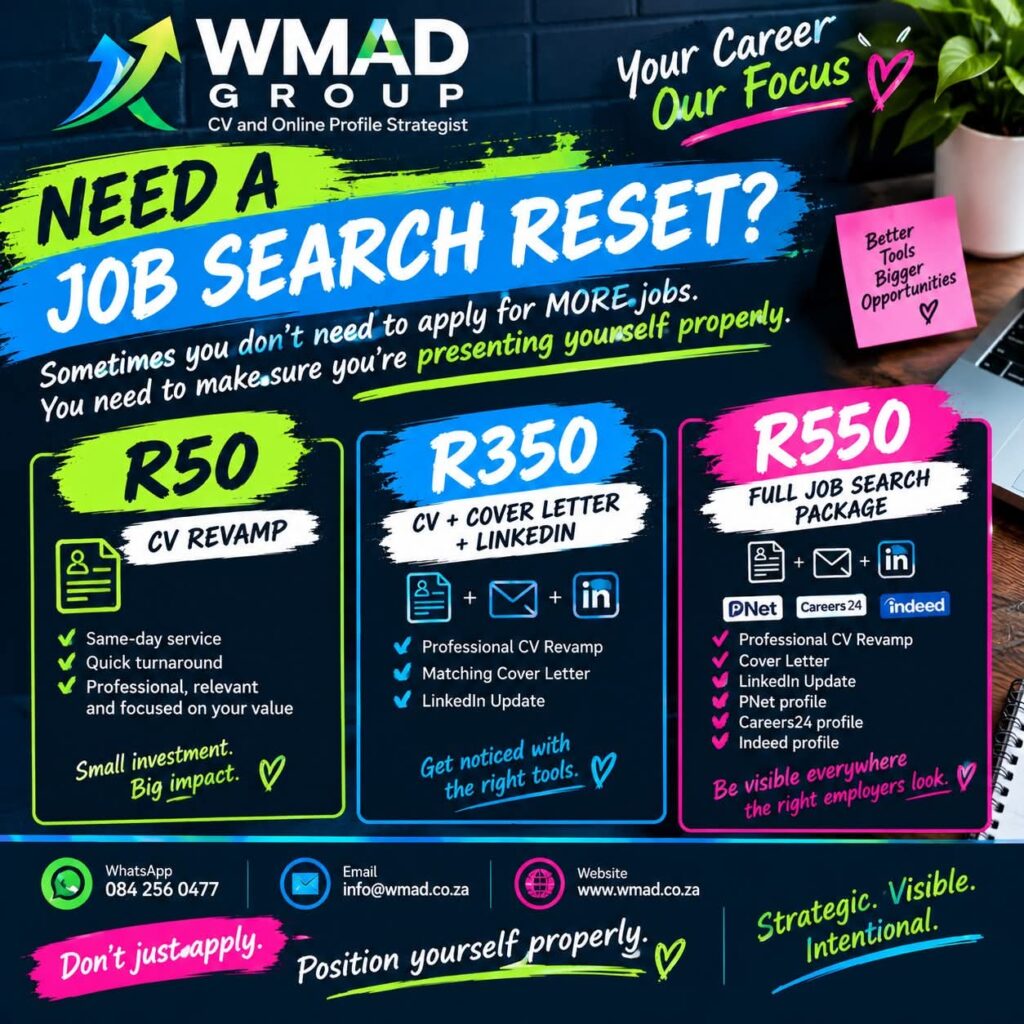
???? October CV Revamp Special — R50
???? R350: CV Revamp + Cover Letter + LinkedIn Update
???? R550: Full package, including CV, Cover Letter, LinkedIn Update, PNet, Careers24 and Indeed profiles
???? WhatsApp: 084 256 0477
???? info@wmad.co.za
???? https://wmad.co.za/
The R50 same-day service is subject to workload and receipt of all required information.
WMAD Group — Strategic. Visible. Intentional.

